Speed Linx

Talk to an expert
Websites for airport shuttles and airport transfers

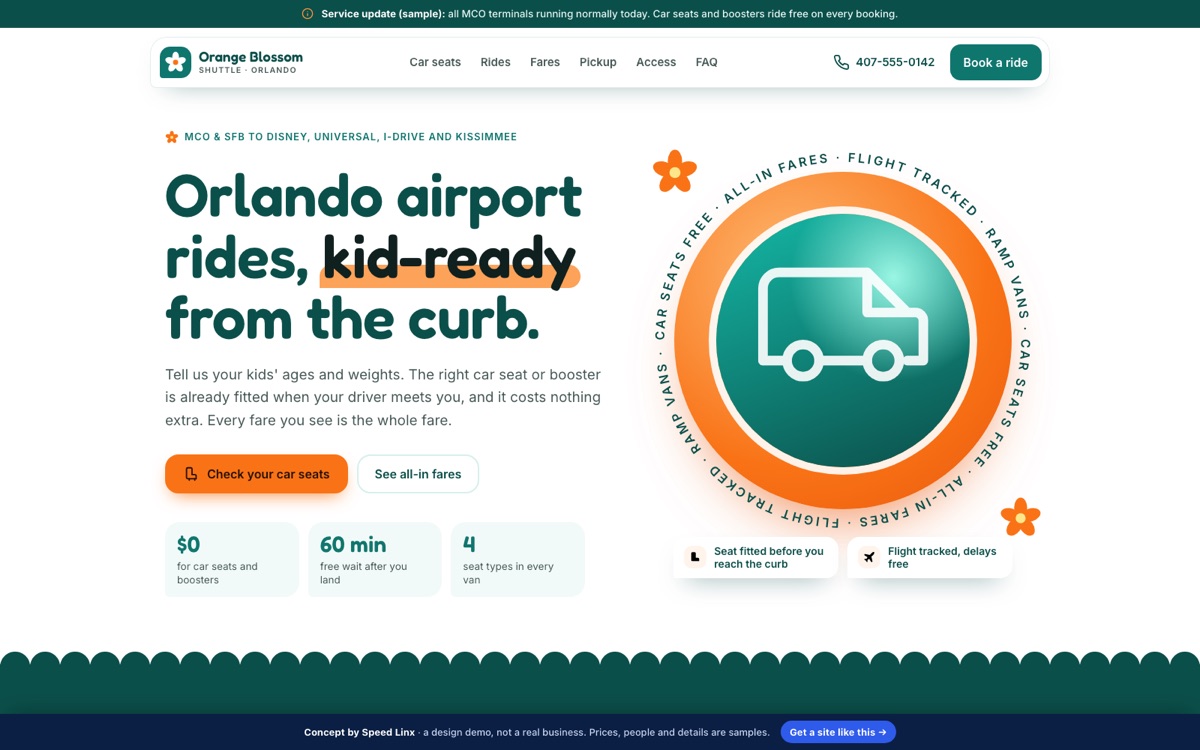
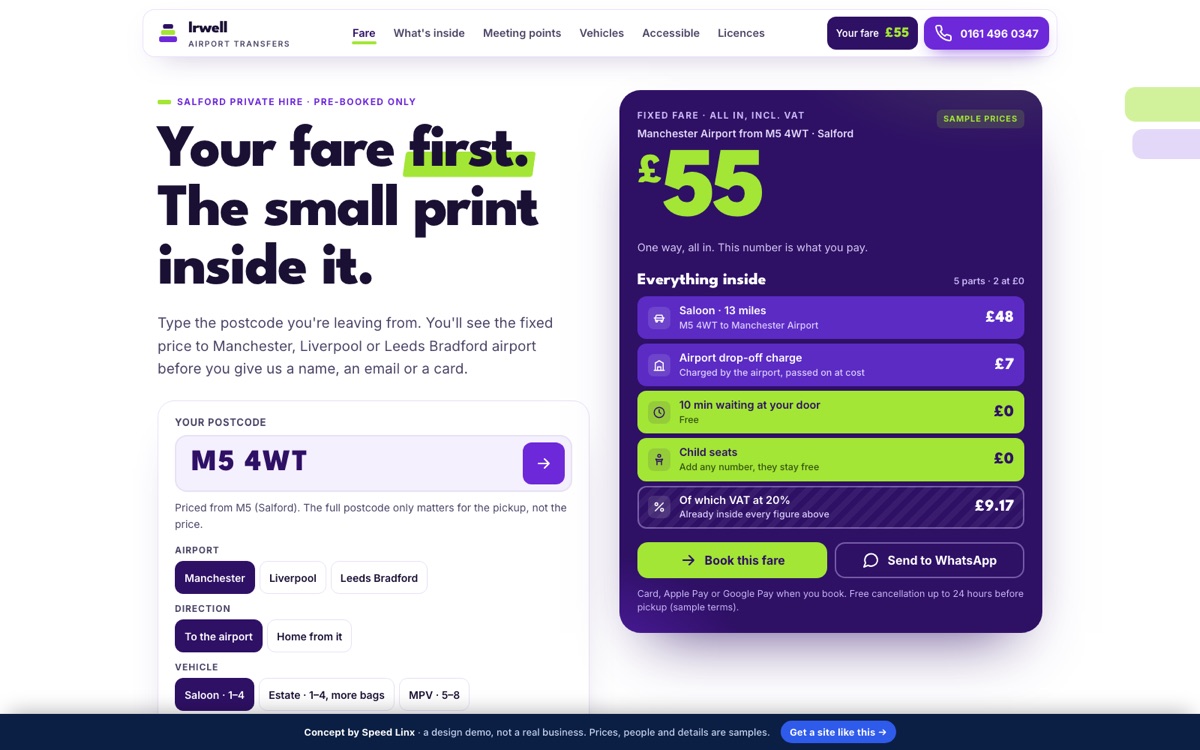
Airport shuttle website design that shows the fare, the licence and the pickup point — and turns a nervous traveller into a booked seat.

Someone booking an airport shuttle is planning around a flight they cannot miss. Before they book a seat on a shared van, a private transfer or a scheduled airporter, they want to know the full fare, where the driver will meet them, what happens if the flight is late, whether the vehicle takes a wheelchair or a ski bag, and that the company is properly licensed. We design for all of that, for airport shuttles and van transfer firms in the US, Canada and Australia, and airport transfers firms in the UK. Built in 7 days, guaranteed, and hosted on our own fast servers.
What every shuttle site gets
  • Book from the first screenRoute, date, passengers and bags in one card
  • Fares with everything inTax, airport fees and extras shown up front
  • Licence you can checkNumber, issuing body and a lookup link
  • Pickup and delay rulesMeeting point per terminal, free waiting time
7-day guaranteeLive in 7 days or your money back
The short answer

What makes a good airport shuttle website?

A good airport shuttle website gets a traveller from “will they really be there?” to a booked seat or a confirmed transfer, and gives them facts they can check. In practice that means a booking card in the first screen, fares with tax, airport fees and extras included, your licence or authority number with a link to the official lookup, the exact meeting point at each terminal, a clear rule for late flights and free waiting time, an accessible-ride path, and separate pages for shared rides, private transfers and each airport you serve.

The galleries, template stores and transportation design guides that rank in this space talk about mobile layouts, quote forms, fleet photos and route maps. Those matter, but none of the top pages we read mention licence numbers, insurance, all-in fares, flight-delay rules or wheelchair-accessible rides. In October 2026 we reviewed 211 real airport shuttle and airport transfer websites in the US, UK, Canada and Australia, and those were exactly the gaps we found most often. Every section below comes from that review.

What travellers look for

What do people check before they book an airport shuttle?

A missed pickup can mean a missed flight. Travellers compare shuttle and airport transfer websites for certainty: a price they can plan around, a place to meet and proof that the company is real.
What will it cost, all in?The full fare for their party and bags, with tax, airport fees, fuel levies and extras shown before checkout.
Where do I meet the driver?The exact door, island or sign at each terminal, ideally with a photo.
What if my flight is late?Whether you track flights, how long you wait for free and what happens after a long delay.
Are you licensed and insured?Your licence or authority number with the issuing body, and the insurance you carry.
Shared or private?How many stops a shared ride makes, how long it may take, and when private is worth paying for.
Will it fit us?Seats, luggage space, car seats, skis, bikes and wheelchair access, before they pay.
What we found

What did we find when we reviewed 211 airport shuttle websites?

These figures come from the home pages we reviewed on 20 October 2026: 52 in the US, 56 in the UK, 52 in Canada and 51 in Australia. We read each page’s text, so a number shown only in an image or on another page was not counted — treat them as a fair picture, not a census.
CountryWhat we sawWhy it matters
United States0 of 52 shuttle sites showed a USDOT number, and only 1 showed a state PUC number. 39 said nothing about licence or insurance. 5 called themselves “official”, “preferred” or “authorized” at an airport with no permit shown. Only 4 explained how to book a wheelchair-accessible ride.Interstate for-hire passenger carriers need a USDOT number, and anyone can look a carrier up in the FMCSA’s public database. Private shuttle firms also have ADA duties for accessible service.
United KingdomOnly 9 of 56 airport transfers sites showed a private hire operator licence number, and 39 showed neither a number nor the licensing authority. None of the 19 firms advertising 9+ seat minibuses or coaches showed a PSV operator licence number. Only 13 showed a company number, and only 18 showed any price.Vehicles with 9 or more passenger seats need a PSV operator licence, limited companies must show their number on their website, and the CAP Code expects VAT-inclusive consumer prices.
CanadaOnly 1 of 52 sites showed a regulator or licence number. 0 of 11 British Columbia sites showed a Passenger Transportation Board licence, and 0 of 6 Québec firms mentioned a CTQ authorization. Only 13 showed a real fare, and only about 12 said what happens when a flight is late.Provinces license shuttle and limo operators, and the Competition Bureau treats fares that leave out mandatory fees, such as a fuel surcharge, as drip pricing.
AustraliaOnly 3 of 51 sites showed an accreditation or authorisation number, 12 claimed to be “accredited” or “licensed” with no number, and only 7 showed an ABN. 33 showed no price, and fuel levies appeared at checkout with no amount on 3.WA requires the authorisation number or provider name in booking-service advertising, and the ACCC expects a single total price, not fees added late.
All fourLorem ipsum, placeholder phone numbers, copy pasted from another city, services still advertised after they stopped, and old shuttle domains now showing gambling or car-insurance pages. In the US, 14 old shuttle domains we checked now park on a holding page.A traveller trusting you with a flight connection reads a careless website as a careless operator. We check every page before launch.
Source: our own review of 211 airport shuttle and airport transfer websites, 20 October 2026. No business is named here. Not legal advice — your regulator has the final word.
The rules

What do the rules say an airport shuttle website must show or avoid?

Airport shuttles and airport transfers are licensed transport in every country we looked at, so the rules cover who you are as well as how you sell. These are examples from official sources that we build into the design, so the number or notice sits where a traveller looks — not buried in a footer. Where we could not confirm how a rule applies, we say “check with your regulator”. It is a summary to help you brief us, not legal advice.
WhereWhat the rule says
US: registration and insuranceFor-hire carriers of passengers in interstate commerce, including small vans, need a USDOT number and operating authority, and travellers can look a carrier up on SAFER. Federal minimum insurance for for-hire passenger carriers is $1.5 million for vehicles seating 15 or fewer, including the driver, and $5 million for 16 or more. Intrastate work is licensed by the state, such as the CPUC in California. Airport pickup permits are set airport by airport — check with the airport before claiming “official” status.
US: accessibility and reviewsPrivate firms primarily in the business of carrying people have duties under 49 CFR Part 37, and the DOJ has web accessibility guidance for business websites. The FTC’s rule on consumer reviews bans fake, bought and undisclosed insider reviews and misleading review displays.
UK: licensingPrivate hire operators are licensed by the local council (1976 Act) or, in London, by TfL. Vehicles with 9 or more passenger seats, and most services that charge separate fares, need a PSV operator licence from the Traffic Commissioner, which travellers can check online. Whether a seat-sold shuttle in a small van needs one depends on how you run it — check with the Traffic Commissioner.
UK: prices, reviews and identityThe CAP Code expects VAT-inclusive consumer prices and evidence for claims such as “No.1” or “cheapest”. The DMCC Act 2024 covers drip pricing and fake reviews, and the CMA treats fake and concealed incentivised reviews as unlawful. Limited companies must show their name, number and registered office on their website.
Canada: licensingOntario buses seating 10+ need a CVOR, and limos and sedans are licensed by municipalities. In British Columbia, limousine and shuttle operators need a Passenger Transportation Board licence. Alberta requires a Safety Fitness Certificate for vehicles seating 11+ including the driver. Québec permits come from the CTQ, and Nova Scotia motor carriers from the UARB — check the exact class for your service with each one.
Canada: prices and languageA fare that leaves out mandatory fees, such as a fuel surcharge or booking fee, is drip pricing; only government charges such as sales tax may be added on top. Reviews by staff or owners that hide the connection can breach the Competition Act (Competition Bureau). A website marketing services in Québec must be available in French.
Australia: authorisationEach state regulates booked passenger transport: NSW Point to Point, Safe Transport Victoria, Queensland TMR and the WA Department of Transport. In WA, booking-service advertising must include the authorisation number, provider name or trading name, and every fare must be agreed in advance and given in writing. Cross-border NSW–QLD runs — check with both states.
Australia: prices and reviewsThe ACCC expects a single total price, without unavoidable fees such as fuel levies, booking fees or card fees added late in checkout. The ACCC also bans fake, selectively edited and undisclosed-incentive reviews.
Sources checked October 2026. Rules change — we re-check before every launch.
Two kinds of shuttle

Should a shared shuttle website work differently from a private transfer site?

Yes. A shared-ride or scheduled airporter customer is buying a seat at a time; a private airport transfer customer is buying a vehicle for their party. Most sites we reviewed used one layout for both, and a few still advertised shared rides they had stopped running.
What a shared-ride customer looks for
  • The next departures from their stop, with seats left
  • A per-person fare, and how it changes for 2, 3 or 4
  • How many stops and how long the ride may take
  • The cut-off time for booking online
  • What happens if the flight lands after the last run
What a private transfer customer looks for
  • A fixed fare for the vehicle, all in
  • Flight tracking and free waiting time
  • Meet and greet with a name board
  • Seats, luggage space and car seats by vehicle
  • The driver’s name and contact before the day
Licences

How should an airport shuttle website show its licence and insurance?

As a number a traveller can check, not a word. Across all four countries, the most common gap we found was a claim — “licensed”, “insured”, “official airport operator” — with nothing behind it. 0 of 52 US sites showed a USDOT number, only 9 of 56 UK sites gave a private hire operator licence number, only 1 of 52 Canadian sites showed any regulator number, and only 3 of 51 Australian sites gave an accreditation or authorisation number. None of the 19 UK firms advertising 9+ seat minibuses showed a PSV operator licence number.

We build a small credentials card into the footer and the booking step: each licence or permit with the issuing body, a link to the official lookup where one exists, your insurance level, your company number or ABN, and any airport permit you really hold. If you serve two states or provinces, each one gets its own line. That way your most important proof is also the easiest thing on the page to check.

Fares

Should an airport transfer website show its fares?

Yes, all in, before checkout. Only 18 of 56 UK sites showed any price, 13 of 52 in Canada showed a real fare, and 33 of 51 Australian sites showed none. Where fares did appear, they were often not the full price: fuel levies shown only at checkout, “excluding taxes and fees”, and surcharges kept in the FAQ. A traveller who sees the full fare up front books with more confidence and does not argue at the kerb.

The rules point the same way. In the UK, consumer prices should include VAT. In Canada, the Competition Bureau treats fares that leave out mandatory fees as drip pricing. In Australia, the ACCC expects a single total price, and in WA the fare must be agreed in writing before the trip.

So we build fare pages and booking steps with context: per-person and per-vehicle fares, what is included such as bags, tolls and airport fees, the price of extras such as car seats or ski bags, night or holiday surcharges, the tax position and the date the figures were last checked. You set the numbers; we make sure the page says them clearly and is easy to update.

Pages

Which pages does an airport shuttle website need?

Every site is planned around the work you want more of — shared seats, private airport transfers, ski or cruise runs, groups or corporate accounts. A typical airport shuttle or airport transfers website is built from these page types.
PageWhat it does
HomeWhat you run and where, a booking card, and your licence and reviews in the first screen
AirportsOne page per airport you really serve, with the meeting point at each terminal and a photo
Routes and timetablesStops, departure times, booking cut-offs and seats left for shared or scheduled runs
FaresPer-person and per-vehicle fares, extras, surcharges, the tax position and when the figures were checked
Delays and waitingFlight tracking, free waiting time, what happens after a long delay, and the cancellation rules
Fleet and accessibilitySeats, luggage space, car seats and how to book a wheelchair-accessible ride
CredentialsLicence and permit numbers with lookup links, insurance, company number or ABN
Groups and accountsGroup quotes, events, hotels and corporate accounts, with a clear reply time
Service updatesA notice that changes the home page when a route stops, moves or is suspended
How it works

How does an airport shuttle website go from brief to live in 7 days?

01BriefRoutes, fares, licences and the rules where you work.
02DesignYour own concept, not a shuttle template.
03BuildAirport, route, fare and credential pages, rules built in.
04LaunchLive on your domain in 7 days, guaranteed.
After launch

Who keeps the site up to date through the travel peaks?

We do. Your site runs on servers we manage ourselves, and a monthly care plan covers updates, backups and the changes a shuttle firm makes all year — new timetables, revised fares, a moved pickup point, a renewed licence, a ski or cruise season, a service notice. Booking forms are tested so bookings reach you, even at holiday peaks. And we keep your domain renewed, so your name never ends up on someone else’s page.
  • LiteSpeed web servers built for speed
  • Each site isolated in its own container
  • Malware scanning and a web firewall
  • Off-site backups
  • Free Cloudflare on our account
Care plan basics
  • UpdatesApplied and checked
  • BackupsAutomatic, off-site
  • Fares and timetablesChanged when you need
  • MonitoringUptime and security
FAQ

Questions we get asked

How much does an airport shuttle website cost?
It depends on the number of airport, route and fare pages and features such as seat booking, timetables, flight-number lookup or account booking. We give you a fixed quote after a short call, and the launch date is guaranteed.
Can travellers book a seat or a vehicle online?
Yes. We connect the booking or dispatch tool you already use, or set one up, so travellers choose shared or private, the route, passengers and bags, and see the full fare before they pay.
Should we show our USDOT or licence number on the website?
We recommend it. Travellers can check it in seconds, and it sets you apart from the many sites that only say “licensed”. In WA, booking-service advertising must include the authorisation number or provider name; elsewhere, check with your regulator what is required.
We are a UK airport transfers firm. What should the site show?
Your private hire operator licence number and council or TfL, a PSV operator licence if you run 9+ seat vehicles, fares including VAT, free waiting time and the late-flight rule, the meeting point at each terminal, and your company number and registered office if you are a limited company.
How should we explain flight delays and waiting time?
In one short, clear rule near the booking button and on each airport page: whether you track flights, how many minutes of waiting are free, what you charge after that, and what happens if the flight lands after your last run.
Do we need a French site in Québec?
If your website markets services in Québec, it must be available in French. We build both languages as equals, not a machine-translated copy.
Can you improve our current site instead of starting again?
Yes. We can redesign it while keeping the search rankings it has earned — see website redesign.
Something else on your mind? Ask us directly →
Keep exploring

Related services

Airport shuttle SEOGet found for the runs you want.Explore →
Local SEOShow up in your area.Explore →
Website care plansUpdates, backups, security.Explore →

Let’s talk about your project.

A free 30-minute call with the people who would do the work. No obligation, no sales script.