Speed Linx

Talk to an expert
Websites for junk removal and rubbish clearance firms

Junk removal website design that shows the licence, the full price and where the load goes — and turns a photo into a booked pickup.

Someone who wants a sofa, a garage or a whole house cleared is about to hand their rubbish to a stranger with a truck. Before they book, they compare a few junk removal websites and look for proof: a price they can plan around, a licence or carrier number they can check, what you will not take, where their things will end up and reviews they can trust. We design for all of that, for junk removal and hauling firms in the US and Canada, rubbish removal and house clearance firms in the UK and rubbish removal firms in Australia. Built in 7 days, guaranteed, and hosted on our own fast servers.
What every junk removal site gets
  • Photo to price in minutesText, WhatsApp or upload, then book a slot
  • Licence you can checkNumber and register link beside the claim
  • Prices with everything inTax, disposal and surcharges shown
  • Where the load goesDonate, recycle, landfill — honestly
7-day guaranteeLive in 7 days or your money back
The short answer

What makes a good junk removal website?

A good junk removal website gets a customer from “can I trust you with this?” to a booked pickup or a fixed quote, and gives them proof they can check. In practice that means a photo-quote or booking card in the first screen, prices by load size with tax, disposal and common surcharges included, your waste carrier, hauler permit or licence number with a link to the register, a clear list of what you will not take, honest figures on what gets donated or recycled, and separate pages for house clearances, furniture, appliances, garden waste and construction debris.

The template stores, examples lists and agency pages that rank for junk removal website design and junk removal web design talk about one booking button, real crew photos, big review counts and “pay only for the space you use”. Those matter, but none of the top results we read mention licence or carrier numbers, the UK householder duty of care, proof for recycling percentages, prices with tax in, or hazardous items. In October 2026 we reviewed 286 real junk removal, rubbish removal and house clearance websites in the US, UK, Canada and Australia, and those were exactly the gaps we found most often. Every section below comes from that review.

What customers look for

What do people check before they book a junk removal or rubbish clearance firm?

A house clearance can be the last job in a family home, and even a single sofa means letting a crew into your house. Customers look for proof, a price they can plan around and a clear idea of where their things go.
What will it cost?Prices by load size or item, with tax, disposal, stairs and heavy-item fees shown, not left for the day.
Are you allowed to carry waste?Your waste carrier, hauler permit or licence number, with a link to the public register.
Where will my things go?What is donated, recycled or sent to landfill, with named partners and receipts where you give them.
What won’t you take?Asbestos, gas bottles, chemicals, paint and other items you cannot legally carry, and what you do with fridges and e-waste.
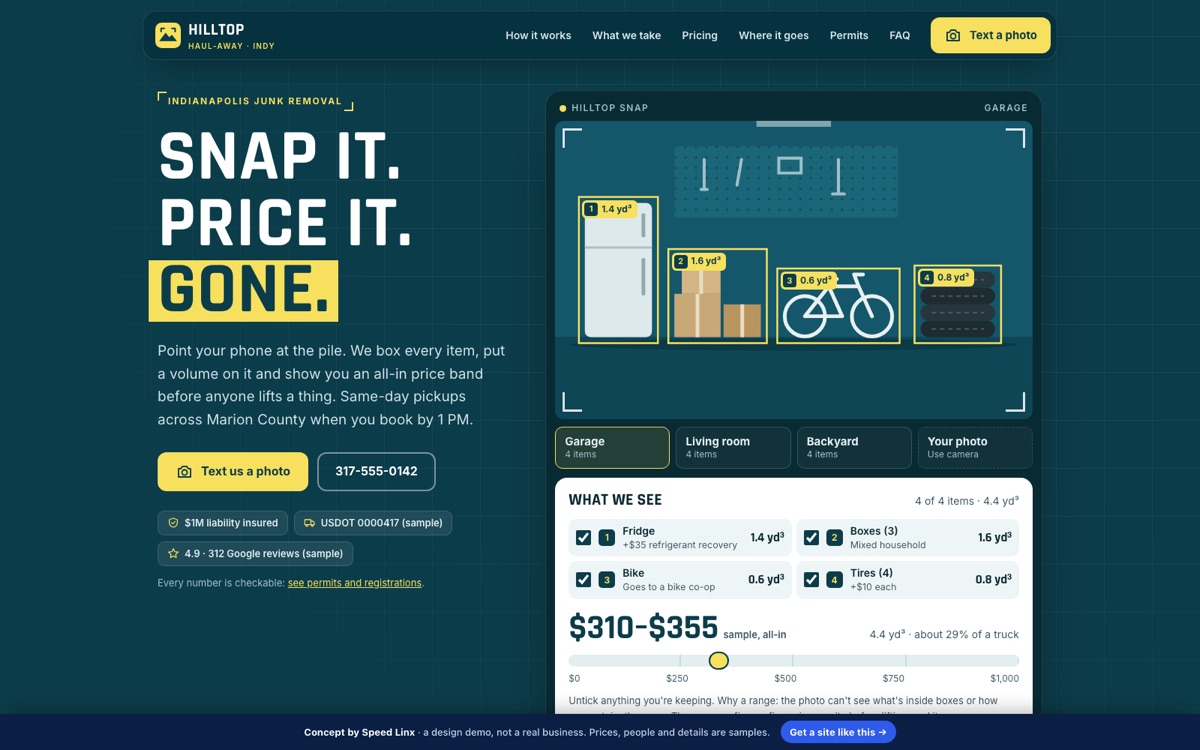
Can I just send a photo?Text, WhatsApp or upload a photo and get a price back, then pick a slot — no site visit for small jobs.
Are you a real, insured business?Your insurance type and amount, company number or ABN, and reviews that name the platform and count.
What we found

What did we find when we reviewed 286 junk removal websites?

These figures come from the home pages we reviewed on 20 October 2026: 62 in the US, 78 in the UK, 72 in Canada and 74 in Australia. We read each page’s text, so a number shown only in an image, on a truck in a photo or on another page was not counted — treat them as a fair picture, not a census. Nothing was checked against a register.
CountryWhat we sawWhy it matters
United StatesOnly 3 of 62 junk removal sites showed any registration or permit number. About 36 said “licensed and insured” with nothing to check, and about 23 said nothing at all. 13 published a recycling or diversion percentage, none with a method, and 4 contradicted themselves on the same page. 5 showed conflicting review counts, and 6 claimed “24/7” against their own posted hours.Many cities and counties issue hauler permits, and the FTC’s Green Guides expect a recycling claim to be specific and backed by evidence. A number a customer can look up beats “fully licensed”.
United Kingdom40 of 78 rubbish removal and house clearance sites showed a waste carrier number, and about 30 claimed to be licensed without one. Only 13 linked to the public register. None of the 3 Northern Ireland firms showed an NIEA number, and none of the 3 Welsh firms an NRW number. 27 claimed a recycling percentage with no visible evidence, 4 of them 100%. Only 3 explained the householder duty of care.Householders can be fined if their waste ends up with an unregistered carrier, and councils tell them to check the register. A carrier number with a register link answers their first question.
Canada0 of 72 junk removal sites printed a waste-transport registration or permit number, and only 3 Ontario sites mentioned their environmental registration at all. 25 said “licensed” with no issuer. Workers’ compensation appeared on 7, and on none of the 28 in Alberta, Québec and Nova Scotia. 32 showed a dollar figure, but only about 8 said whether tax and disposal were included. 4 of 11 Québec sites were English-first.The Competition Bureau treats prices that leave out mandatory fees as drip pricing, and since 2024 environmental claims need proper substantiation.
AustraliaOnly 1 of 74 rubbish removal sites showed an EPA permit or registration number, and 11 said “licensed” without saying what licence. 4 advertised asbestos, chemicals or hazardous waste with no licence shown. An ABN appeared on 15, a public liability amount on 3. About 33 promised “no hidden fees” while 55 showed no price, and 3 headline prices were ex-GST.Ordinary household rubbish needs no transport licence in most states, but regulated waste does. The ACCC expects one total price, with GST and unavoidable fees, at least as prominent as any part of it.
All fourCounters stuck at “0+”, a placeholder “(XXX) XXX-XXXX” phone number, buttons linking to “#”, another city’s name on the page, a Berlin address on a Nottingham site, and in Canada, casino spam and leftover template text from other businesses on live sites.Junk removal is sold on turning up and doing what you said. A careless website makes a customer doubt the rest. We check every page before launch.
Source: our own review of 286 junk removal, rubbish removal and house clearance websites, 20 October 2026. No business is named here. Not legal advice — your regulator has the final word.
The rules

What do the rules say a junk removal website must show or avoid?

The rules that matter for junk removal and rubbish clearance are about who may carry waste, what you may carry, where it goes, and how you advertise prices, recycling and reviews. These are examples from official sources that we build into the design, so the number or notice sits where a customer looks — not buried in a footer. Where we could not confirm how a rule applies, we say “check with your regulator”. It is a summary to help you brief us, not legal advice.
WhereWhat the rule says
US: permits and trucksThere is no national junk removal licence; permits are set by cities, counties and states. Examples: Los Angeles requires a waste hauler permit, and Salt Lake County a waste hauler permit. Commercial trucks may need a USDOT number. Check with your city and state before showing “licensed”.
US: appliances, e-waste and claimsFridges, freezers and AC units fall under the EPA’s refrigerant safe-disposal rule, and many states restrict electronics in landfill (EPA electronics guidance). Recycling and “eco” claims fall under the Green Guides, and the FTC’s rule on consumer reviews bans fake, bought and AI-generated reviews and review suppression.
UK: carriers and duty of careAnyone carrying other people’s waste must register as a waste carrier — with the Environment Agency (public register), SEPA, Natural Resources Wales or NIEA. Transfer notes are part of the duty of care code, and English councils can fine householders up to £600 if their waste ends up with an unregistered carrier (fixed penalty guidance).
UK: claims, prices and identityRecycling claims must be backed by evidence under CAP Code section 11 and the ASA’s recycling advice, and follow the Green Claims Code; absolute claims like “100% recycled” need a high level of proof. Drip pricing and fake reviews are unfair practices (CMA207, CMA fake reviews). Limited companies must show their name, number and registered office on their website.
CanadaIn Ontario, most waste transport needs an environmental permission (ECA or EASR registration); whether every small household hauler is covered we could not confirm — check with the ministry. Other provinces rely mainly on municipal licences. Environmental claims need substantiation under the Competition Bureau’s 2025 guidelines, and a “from” price that leaves out fixed fees is drip pricing. Text-a-photo follow-ups need consent under CASL.
QuébecA website marketing services in Québec must be available in French. An RBQ number is a construction licence, not a waste credential — we do not present it as one.
Australia: licencesGeneral household rubbish needs no transport licence in most states, but regulated waste does: NSW EPA for trackable waste, EPA Victoria permits for reportable priority waste, Queensland for regulated waste and WA for controlled waste. In South Australia, check with the EPA whether your work needs a licence. Asbestos has its own rules in every state.
Australia: prices, claims and reviewsThe ACCC expects one total price, with GST and unavoidable fees such as tip fees and card surcharges, at least as prominent as any part price. Vague “eco-friendly” wording and unproven recycling percentages are a greenwashing risk, and the ACCC bans fake and selectively shown reviews.
Sources checked October 2026. Rules change — we re-check before every launch.
Two kinds of job

Should a house clearance website work differently from a quick junk pickup site?

Yes. A customer with one sofa or a trailer of garden waste wants a fast price and a slot; a family clearing a parent’s home, or an executor, is choosing someone to handle a whole house with care. Most sites we reviewed used one layout and one message for both.
What a quick-pickup customer looks for
  • A price for their load or item, with tax and fees in
  • A photo quote by text, WhatsApp or upload
  • Same-day, with a real cut-off time
  • What you will not take
  • An online slot, not a call-back
What a house clearance customer looks for
  • A site visit or video survey and a fixed quote
  • Keep, donate, sell and dispose handled room by room
  • Valuables and documents set aside
  • Your carrier or licence number and insurance
  • Key handover when they cannot be there
Licences

How should a junk removal website show licences and permits?

As a number with a link, next to the claim. Across all four countries, the most common problem we found was “fully licensed” with nothing a customer could check. Only 3 of 62 US sites showed any registration number, none of 72 Canadian sites printed a waste-transport number, and only 1 of 74 Australian sites showed an EPA number. In the UK, about half did show a carrier number, but only 13 of 78 linked it to the public register.

We build a small credentials card into the first screen and the footer: your waste carrier or hauler permit number and who issued it, a link to the register, upper or lower tier in the UK, your insurance type and amount, and your company number or ABN. Where no licence applies to the work you do, we say so plainly instead of “licensed”, and we list what you will not take — asbestos, gas bottles, chemicals — so customers know before they book.

Recycling claims

Should a junk removal website publish a recycling percentage?

Only if you can show how you got it. A recycling or donation story is a real reason to choose you, and every top-ranking design page we read encourages it. But the figures we found rarely held up: 13 of 62 US sites published a percentage with no method and 4 contradicted themselves; 27 of 78 UK sites claimed one with no visible evidence, 4 of them 100%; about 11 Australian sites quoted unsourced figures. Green claims rules in all four countries expect evidence, and absolute claims need the most.

So we build the story on things you can prove: named charities and recyclers you use, donation receipts, transfer notes or tip dockets, and — if you track it — what share of last month’s loads went where, with the date and how it was measured. If you do not have the figure, we leave it out and show the partners instead.

Prices

Should a junk removal website show prices?

Yes, by load size or item, and with everything in. Only 30 of 78 UK sites showed any £ price, and 55 of 74 Australian sites showed none — while about 33 of those Australian sites promised “no hidden fees”. Where prices did appear, they were often not the full price: ex-GST headline prices in Australia, card surcharges only in the footer, and “from” prices in Canada next to fuel, stairs and mattress surcharges. Only about 8 of 72 Canadian sites said whether tax and disposal were included.

The rules point the same way. In the UK, drip pricing is an unfair practice under the DMCC Act; in Australia, the ACCC expects one total price at least as prominent as any part of it; and in Canada the Competition Bureau treats prices that leave out mandatory fees as misleading.

So we build price pages with context: what each load size looks like, item prices for the usual heavy things such as mattresses, fridges and hot tubs, what changes the price such as stairs or weight, the tax position and the date the figures were last checked. You set the numbers; we make sure the page says them clearly and is easy to update.

Pages

Which pages does a junk removal website need?

Every site is planned around the work you want more of — single items, garage and garden clearances, house clearances, construction debris or commercial contracts. A typical junk removal, rubbish removal or house clearance website is built from these page types.
PageWhat it does
HomeWhat you take and where, a photo-quote or booking card, and your licence and reviews in the first screen
ServicesOne page each for furniture, appliances, garden waste, garage, house clearance, construction debris and office clear-outs
PricesLoad sizes and item prices, what is included, surcharges, the tax position and when the figures were checked
What we take and don’tAccepted items, items you cannot carry and why, and how fridges, mattresses and e-waste are handled
Where it goesNamed charities and recyclers, receipts or transfer notes, and any figures with their method
AreasReal pages for the towns and suburbs you serve, with same-day cut-offs and local notes such as council bulky-item days
CredentialsCarrier or permit number with register link, insurance type and amount, company number or ABN
House clearancesA calmer page for families and executors: surveys, sorting, valuables search and key handover
Reviews and teamGenuine reviews with platform and count, and your own crew and trucks in real photos
How it works

How does a junk removal website go from brief to live in 7 days?

01BriefServices, prices, licences and the rules where you work.
02DesignYour own concept, not a junk removal template.
03BuildServices, prices, area and credentials pages, rules built in.
04LaunchLive on your domain in 7 days, guaranteed.
After launch

Who keeps the site up to date through the busy months?

We do. Your site runs on servers we manage ourselves, and a monthly care plan covers updates, backups and the changes a junk removal firm makes all year — prices revised when tip fees rise, a renewed carrier registration or permit, a new truck or area, spring clear-out and move-out offers, new before-and-after photos. Photo-quote and booking forms are tested so enquiries reach you, even in the busiest weeks.
  • LiteSpeed web servers built for speed
  • Each site isolated in its own container
  • Malware scanning and a web firewall
  • Off-site backups
  • Free Cloudflare on our account
Care plan basics
  • UpdatesApplied and checked
  • BackupsAutomatic, off-site
  • Prices and areasChanged when you need
  • MonitoringUptime and security
Our work

Our junk removal website concepts.

Ideas for junk removal, rubbish removal and house clearance firms, each built from our review of 286 websites in the US, UK, Canada and Australia. Every firm in them is fictional. Click any concept to try it.
FAQ

Questions we get asked

How much does a junk removal website cost?
It depends on the number of service, area and price pages and features such as online booking, a photo-quote form or a load-size price calculator. We give you a fixed quote after a short call, and the launch date is guaranteed.
Can customers send a photo and get a price?
Yes. We set up a photo upload on the site and connect text or WhatsApp quoting if you use it, so customers send a photo, get a price back and pick a slot. Where you send texts, we add the consent wording your country expects.
We are a UK rubbish removal and house clearance firm. What should the site show?
Your waste carrier number with a link to the register for your nation, upper or lower tier, that you give a waste transfer note, prices including VAT and access extras, your company number and registered office if you are a limited company, and a plain note on the householder duty of care.
We say we recycle 90%. Can we keep that on the site?
If you can show how you measured it, yes, with the period and method beside it. If not, we show the charities and recyclers you use and your receipts or transfer notes instead — a claim you can prove does more than a number you cannot.
Do we need a licence number on the site?
It depends on where you work and what you carry. UK firms need a waste carrier registration; some US cities and counties, Ontario and Australian states for regulated waste have their own rules. Where no licence applies, we avoid “licensed” wording and show what customers can check instead. Check with your regulator if you are unsure.
Do we need a French site in Québec?
If your website markets services in Québec, it must be available in French. We build both languages as equals, not a machine-translated copy.
Can you improve our current site instead of starting again?
Yes. We can redesign it while keeping the search rankings it has earned — see website redesign.
Something else on your mind? Ask us directly →
Keep exploring

Related services

Junk removal SEOGet found for the jobs you want.Explore →
Local SEOShow up in your area.Explore →
Website care plansUpdates, backups, security.Explore →

Let’s talk about your project.

A free 30-minute call with the people who would do the work. No obligation, no sales script.