Speed Linx

Talk to an expert
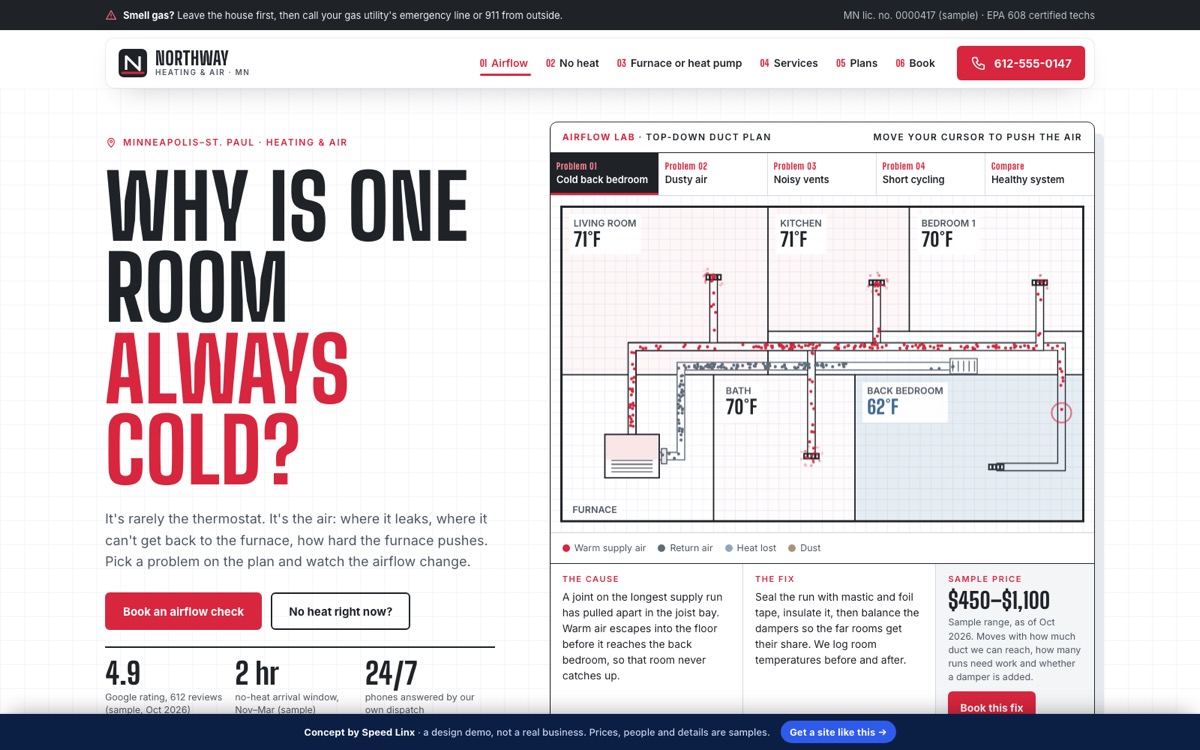
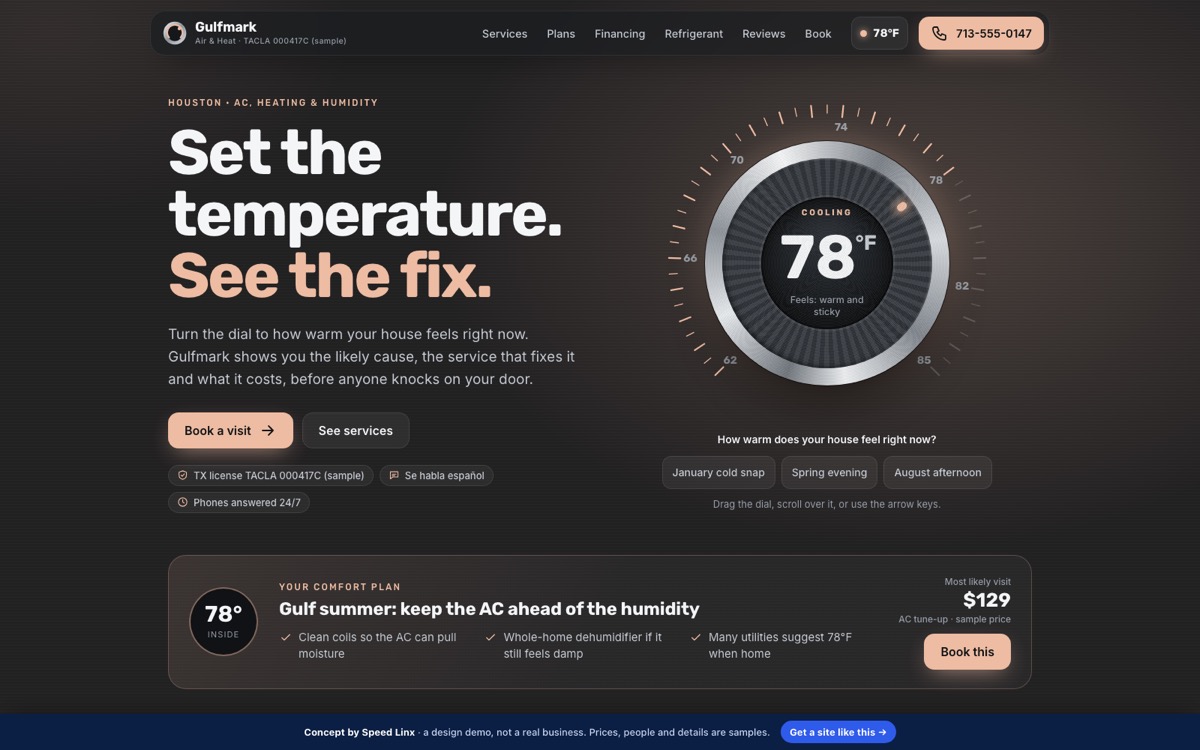
Websites for HVAC companies

HVAC website design that books the call on the hottest day — and proves you are licensed to take it.

People look for an HVAC company when the house is too hot, too cold or the system has just died. An HVAC website has to turn that moment into a booked service call, show the licences and certifications your local rules expect, and talk about rebates, financing and new equipment without promising credits that have ended or prices nobody can get. We design for all three, for HVAC contractors in the US, heating engineers and heat pump installers in the UK, heating and cooling companies in Canada and air conditioning businesses in Australia. Built in 7 days, guaranteed, and hosted on our own fast servers.
What every HVAC site gets
  • Service-call bookingBook, call or text in the first screen
  • Licence in plain sightWhere your local rules expect it
  • No heat, no cool pathSafe first checks, then a real arrival time
  • Honest offersRebates, finance and “free” done right
7-day guaranteeLive in 7 days or your money back
The short answer

What makes a good HVAC website?

A good HVAC website gets an uncomfortable homeowner to book a service call within a minute, and gives them reasons to pick you over the next company on the list. In practice that means a working booking button and a phone number on every screen, your licence or registration number shown where your local rules expect it, the certifications your technicians really hold, an honest after-hours fee and response time, separate pages for repair, replacement, maintenance plans and heat pumps, and rebate and financing pages that are accurate this month, not three years ago.

The agency pages, examples lists and design galleries that rank for this search talk about mobile layouts, calls to action and review widgets. Those matter, but none of the top results we read mention licence numbers in ads, refrigerant certification, the end of the US heat pump tax credit, finance disclosure rules or anything outside the US. In October 2026 we reviewed 227 real heating and cooling websites in the US, UK, Canada and Australia, and those were exactly the gaps we found most often. Every section below comes from that review.

What homeowners look for

What do homeowners check before they call an HVAC company?

A broken furnace or air conditioner is urgent, and a new system is one of the biggest bills a household pays. People look for speed and proof first, and price second.
Can you come today?Booking that works, a realistic arrival window and honest hours — not “24/7” above opening times that say otherwise.
Are you licensed and certified?The actual licence or registration number, and certifications such as EPA 608, Gas Safe, MCS, ARC or TSBC where they apply.
What will the visit cost?The diagnostic or call-out fee, any after-hours charge, and typical ranges for common repairs.
Repair or replace?A plain guide to when replacement makes sense, with current efficiency ratings and refrigerants explained.
Which rebates are real?Programmes that are open now, with the official link and the date you last checked them.
Will you look after it?Maintenance plans with real prices, warranties in plain words and genuine reviews.
What we found

What did we find when we reviewed 227 HVAC websites?

These figures come from the home pages we reviewed on 20 October 2026: 54 in the US, 62 in the UK, 54 in Canada and 57 in Australia. We read each home page’s text, so a number shown only in an image or on another page was not counted — treat them as a fair picture, not a census.
CountryWhat we sawWhy it matters
United StatesAbout 20 of 54 sites showed no state licence number at all, and only about 25 showed one that was clearly an HVAC or mechanical licence. Sites in Florida, Washington and Texas, where ads must carry the number, showed none. None named EPA 608 certification. 5 still promoted the federal heat pump tax credit, and 12 or more had “Book Online” buttons that went nowhere.Where a number is required, your website is usually an ad. A credit that has ended is a promise you cannot keep, and a dead booking button loses the call.
United KingdomOnly 6 of about 55 gas firms showed a Gas Safe number in text; the rest showed a logo or just the words. Only 1 site showed an MCS number, though 14 led with heat pumps. Several showed homeowner prices “+VAT”, and some grant banners used out-of-date or loose figures.A number with the registered trading name turns a logo into proof. Heat pump grants are paid only through MCS-certified installers, and consumer prices should include VAT.
CanadaIn BC, 3 of 9 sites showed no Technical Safety BC contractor number. In Quebec, 5 of 6 showed an RBQ number. Only about 6 of 19 Ontario independents showed a TSSA number, and no Alberta or Nova Scotia site showed a licence number. Some pages still promoted the closed Greener Homes Grant.BC and Quebec require the number in advertising, websites included. A closed rebate on your site is a claim a homeowner will hold you to.
Australia9 of 15 New South Wales sites showed no NSW contractor licence number. Many showed an ARC “AU” number labelled as a “licence” — it is the business authorisation, not the technician’s licence. Some “FREE*” and “$0 call-out*” offers hid their conditions.NSW requires the licence number in all advertising. The ACCC expects conditions on “free” to be clear and a single total price where you quote one.
All four“24/7” claims that contradict posted hours, review counts and founding years that disagree on the same page, and template text left on live sites — lorem ipsum, “Slide title”, empty counters.Small errors make a homeowner doubt the big claims. We check every page before launch.
Source: our own review of 227 HVAC home pages, 20 October 2026. No business is named here. Not legal advice — your licensing board or regulator has the final word.
The rules

What do the rules say an HVAC website must show or avoid?

Rules differ by state, province and country. These are examples from official sources that we build into the design, so the number or notice sits where the rule expects it — not buried in a footer. Where we could not confirm the current wording, we say “check with your regulator”. It is a summary to help you brief us, not legal advice.
WhereWhat the rule says
CaliforniaThe CSLB requires your licence number in all advertising, websites included.
Arizona and FloridaArizona ads must carry your ROC number, or link online to a page that shows it prominently (A.R.S. 32-1124). Florida law (s.489.119) requires your certificate or registration number in advertising.
Washington and TexasWashington requires your contractor registration number in advertising (RCW 18.27.100). Texas TDLR lists a missing licence number in an advertisement as a violation for air conditioning contractors — check the current wording with TDLR.
US: refrigerant and efficiencyAnyone who handles refrigerant needs EPA Section 608 certification. New home AC and heat pump systems made from 2025 use lower-GWP refrigerants such as R-454B and R-32 (EPA FAQ), and DOE minimums are set in SEER2 and EER2, not SEER.
US: “free” and financingThe FTC’s “free” rule requires the conditions of a free offer to be stated clearly next to it. Under Regulation Z §1026.24, a monthly payment or “0% for 60 months” in an ad triggers APR, term and down-payment disclosures.
UK: Gas SafeOnly registered businesses may use the Gas Safe brand or a registration number, and only next to the registered trading name; websites count as advertising (Brand Enforcement Policy).
UK: heat pumps and air conBoiler Upgrade Scheme grants in England and Wales are paid only through an MCS-certified installer. Companies installing or servicing air conditioning and heat pumps need F-gas company certification.
UK: grant and price claimsThe ASA has upheld complaints about ads that implied government backing for heating grants. The CAP Code expects consumer prices to include VAT.
British Columbia and QuebecLicensed gas, electrical and refrigeration contractors must show their company name and Technical Safety BC licence number in advertising, websites included. The RBQ requires your licence number on your website and does not allow its logo to be used.
OntarioFuels contractors register with the TSSA — show it; we found no rule requiring it on websites. Furnaces, air conditioners and water heaters cannot be sold door to door unless the homeowner invited you (Ontario rules), and notices of security interest can no longer be registered on title for consumer goods such as rental furnaces.
Australia: ARC and NSWAnyone handling refrigerant needs an ARC Refrigerant Handling Licence, and the business needs a Refrigerant Trading Authorisation. In NSW, air conditioning work needs a Fair Trading licence, and every advertisement must show the licensee’s name and number.
Australia: pricesIf you quote part of a price, the ACCC expects a single total price, including unavoidable charges, shown at least as prominently. A “free install” must make its conditions clear.
Sources checked October 2026. Rules change — we re-check before every launch.
Rebates, credits and finance

What can an HVAC website say about rebates, tax credits and financing?

Plenty — as long as it is current. Rebates and finance are among the most useful pages an HVAC site can have, because they answer the question that stops many installs: can I afford it? They are also where sites go out of date fastest.

In the US, the federal heat pump tax credit (25C) ended for equipment placed in service after 31 December 2025, yet several sites we reviewed still had calculators built around it. Utility and state rebates are often the real offer now, so we build a rebate page that names each programme, links the official source and shows the date it was last checked. In the UK, the Boiler Upgrade Scheme lists £7,500 towards an air source or ground source heat pump and £2,500 for air-to-air, with an extra £1,500 for homes heated by oil or LPG with no mains gas until March 2027 — check GOV.UK for the current terms before quoting it. In Victoria, the minimum co-payment for ducted systems under Victorian Energy Upgrades rose from $1,000 to $3,000 from 30 September 2026, so older “save up to” banners may now overstate the discount.

Finance needs the same care. A line like “from $99 a month” or “0% for 60 months” triggers disclosure rules under US Regulation Z, and in the UK showing credit examples usually means FCA rules on credit broking apply. We design the finance block so the terms sit next to the number, and we never write “free” without the conditions beside it.

Up to date

How does an HVAC website show it is current?

Equipment, refrigerants, ratings and rebates have all changed in the last few years. Homeowners researching a new system notice when a site has not.
What an out-of-date HVAC site says
  • “14 SEER” and no mention of SEER2
  • Nothing on the refrigerant change
  • A tax-credit calculator for a credit that ended
  • “Licensed and insured” with no number
  • “24/7” above weekday-only hours
What we build instead
  • SEER2 and EER2 in plain words
  • A short guide to R-454B, R-32 and existing systems
  • Rebates that are open now, each with a source and date
  • Licence, registration and certification numbers, labelled
  • Real hours, an after-hours fee and an honest arrival time
Pages

Which pages does an HVAC company website need?

Every site is planned around the work you want more of — replacements, heat pumps, maintenance plans or commercial. A typical HVAC site is built from these page types.
PageWhat it does
HomeBooking, phone, licence and real technician photos in the first screen
No heat / no coolSafe first checks (filter, breaker, thermostat), a gas-smell warning, then booking and arrival times
RepairCommon faults, diagnostic or call-out fee, after-hours charge and typical repair ranges
Replacement and installationSizing, efficiency ratings, refrigerants, warranties and financing with its terms
Heat pumpsCold-climate performance, running costs and the grants or rebates that apply where you work
Maintenance plansWhat each plan includes and what it costs, with renewal terms
Rebates and financeOpen programmes with official links and a “last checked” date
Service areasOnly towns you really cover, each with local jobs and photos
About and credentialsOwner story, team, licence and certification details, manufacturer dealer status
How it works

How does an HVAC website go from brief to live in 7 days?

01BriefServices, areas, licences, rebates and the rules where you work.
02DesignYour own concept, not an HVAC template.
03BuildBooking, no-heat path, rebate and finance pages, rules built in.
04LaunchLive on your domain in 7 days, guaranteed.
After launch

Who keeps the site up to date when the seasons change?

We do. Your site runs on servers we manage ourselves, and a monthly care plan covers updates, backups and the changes an HVAC company makes all year — summer and winter offers, a new technician, a licence renewal, a rebate that opens or closes. When a heat wave or cold snap hits, your hours and banners can be updated the same day.
  • LiteSpeed web servers built for speed
  • Each site isolated in its own container
  • Malware scanning and a web firewall
  • Off-site backups
  • Free Cloudflare on our account
Care plan basics
  • UpdatesApplied and checked
  • BackupsAutomatic, off-site
  • Season editsOffers, hours and rebates updated
  • MonitoringUptime and security
FAQ

Questions we get asked

How much does an HVAC website cost?
It depends on the number of service and area pages and features such as online booking, maintenance-plan sign-up or financing. We give you a fixed quote after a short call, and the launch date is guaranteed.
Should an HVAC website show prices?
Yes, where you can be accurate: the diagnostic or call-out fee, any after-hours charge, maintenance-plan prices and typical ranges for common jobs. In the UK and Australia, consumer prices should include VAT or GST. We set the wording with you so it is honest and easy to update.
Where should my licence number go on the website?
Where your local rules expect it. In several US states, in BC, Quebec and NSW, the number must appear in advertising, and a website counts. We usually put it in the header or first screen, on the about page and in your structured data, so it matches your Google listing.
Can we still mention the heat pump tax credit?
Only in the past tense. The US 25C credit ended for equipment placed in service after 31 December 2025, so we remove calculators built around it and point to rebates that are open now. Your customers should check their own tax position with a tax professional.
Can the site cover heating and air conditioning in different seasons?
Yes. We build both sides from the start and switch the home page emphasis between seasons, so the site leads with cooling in summer and heating in winter without a rebuild.
We also do plumbing. Can it be one site?
Yes. Many HVAC companies also offer plumbing or electrical work. We give each trade its own pages and licence details — see plumber website design for how we handle the plumbing side.
Can you improve our current site instead of starting again?
Yes. We can redesign it while keeping the search rankings it has earned — see website redesign.
Something else on your mind? Ask us directly →
Keep exploring

Related services

HVAC SEOGet found before the heat wave.Explore →
Plumber website designSites that book plumbing jobs.Explore →
Website care plansUpdates, backups, security.Explore →

Let’s talk about your project.

A free 30-minute call with the people who would do the work. No obligation, no sales script.